
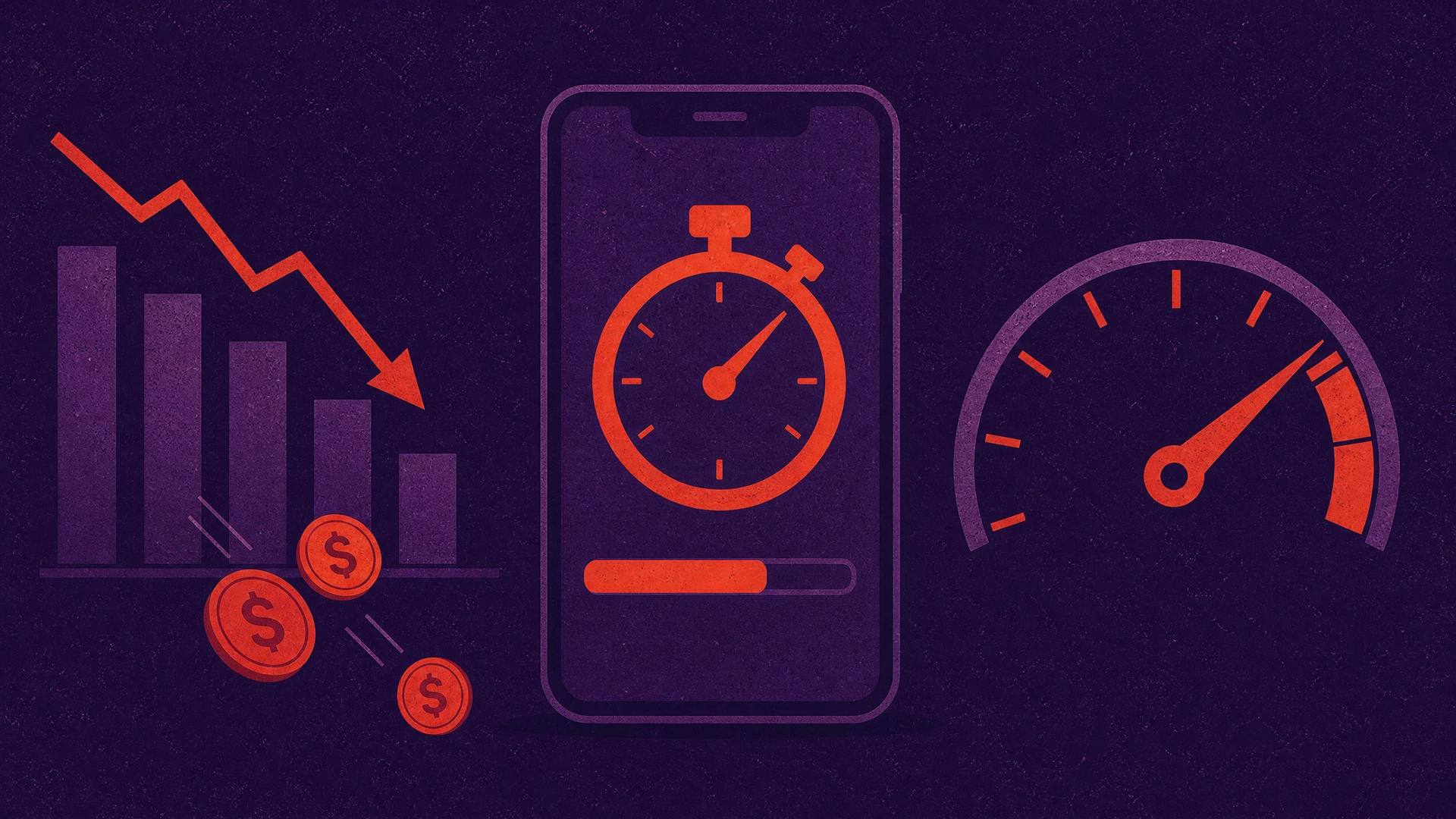
If you're like most small business owners, you evaluate your website on a fast office Wi-Fi connection using a desktop computer. It looks great. It loads instantly. You assume your customers are having the exact same experience. They're not. In 2026, mobile devices account for 62% of all web traffic. Your customers are viewing your site on mid-range smartphones while riding the train, walking down the street, or sitting in areas with patchy 4G coverage. Under these conditions, the average mobile website takes 8.6 seconds to load. This is not just a technical inconvenience. It is a massive financial leak. Welcome to the Three-Second Tax.
- 153% of mobile visitors abandon a website that takes longer than 3 seconds to load.
- 2For every 100 milliseconds of delay, conversion rates drop by approximately 1%.
- 3Only 42% of mobile websites pass all three Core Web Vitals in 2026.
- 4A slow website triggers an invisible Google ranking penalty — a faster competitor will outrank you even with inferior services.
- 5The most common culprits are oversized images, bloated page builders, and excessive third-party scripts.
The Brutal Reality of Mobile Patience
Human patience has evaporated. In the early days of the internet, people would wait for a page to load. Today, speed is the baseline expectation, set by multi-billion-dollar native apps. The data is unforgiving. According to 2026 performance benchmarks, 53% of mobile visitors abandon a website if it takes longer than three seconds to load. If your site takes four seconds to render, more than half of the people who clicked your link, found you on Google, or tapped your ad are gone before they even see your logo. Furthermore, the relationship between speed and revenue is measurable down to the millisecond. For every 100 milliseconds of delay, conversion rates drop by approximately 1%. If your site takes 3.5 seconds to load instead of 1.5 seconds, you are effectively cutting your own conversion rate by 20%. You are paying for the traffic, but you are taxing the transaction.
Google's Core Web Vitals: The Invisible Penalty
If losing half your visitors is not bad enough, a slow website also triggers an invisible penalty from Google. Google measures website speed using a framework called Core Web Vitals. The three metrics — Largest Contentful Paint (LCP), Interaction to Next Paint (INP), and Cumulative Layout Shift (CLS) — evaluate how fast a page loads, how quickly it responds to taps, and how visually stable it is. In 2026, these metrics are not suggestions; they are strictly enforced ranking signals. Only 42% of mobile websites pass all three Core Web Vitals. If your site's in the failing 58%, Google is actively suppressing your search rankings. A faster competitor with inferior services will outrank you simply because their website delivers a better user experience. Speed is the tiebreaker, and right now, you might be losing the tie.
Core Web Vitals: What Google Measures
| Largest Contentful Paint (LCP) | How fast the main content loads. Good: under 2.5s |
| Interaction to Next Paint (INP) | How quickly the page responds to taps. Good: under 200ms |
| Cumulative Layout Shift (CLS) | How visually stable the page is. Good: under 0.1 |
The True Cost of "Good Enough"
Let's run the numbers. Imagine a local service business — perhaps an HVAC company or a boutique retailer — that receives 3,000 mobile visitors a month. Their average transaction value is $500, and their baseline conversion rate is 2%. If their website takes 4.5 seconds to load, they are losing roughly 38% of those visitors to abandonment before the page even renders. That is 1,140 lost visitors. At a 2% conversion rate, that equates to 22 lost sales per month. At $500 per sale, this "good enough" website is costing the business $11,000 every single month in unrealized revenue. That is the Three-Second Tax. It is the money you lose because your template-heavy, unoptimized website cannot keep up with modern consumer expectations.
"A "good enough" website taking 4.5 seconds to load can cost a local service business over $11,000 per month in lost revenue."
— Igniter Digital Performance Analysis, 2026How to Stop the Leak
The good news is that website speed is a highly solvable problem. It doesn't require a complete rebrand, but it does require professional execution. The most common culprits of a slow website are oversized images, bloated page builders, and excessive third-party scripts. Fixing these issues requires moving to a modern, mobile-first architecture. It means compressing images into next-generation formats, deferring non-essential scripts, and utilizing robust hosting infrastructure. This is exactly why Igniter Digital offers Managed Website Design. We don't just build sites that look good on office Wi-Fi. We engineer mobile-first experiences optimized for Core Web Vitals, ensuring that when a customer clicks your link, your business actually shows up.
- 1Next-generation image formats (WebP/AVIF) with lazy loading
- 2Deferred and async loading of non-critical scripts
- 3Mobile-first responsive design built for real-world network conditions
- 4Core Web Vitals monitoring and ongoing optimization
- 5Managed hosting infrastructure designed for speed, not just uptime
Stop Paying the Three-Second Tax
Your website should work as hard as you do. Igniter Digital builds and manages mobile-first websites engineered for Core Web Vitals and real-world performance — not just office Wi-Fi. Let us run a free speed audit on your current site.
Get a Free Speed Audit