
Something changed on Instagram in June and July 2026 — and most small business owners have no idea it happened. Reach is down. Engagement is flat. But the account hasn't broken any rules. No strikes, no warnings, no policy violations. The posts are simply not being recommended anymore.
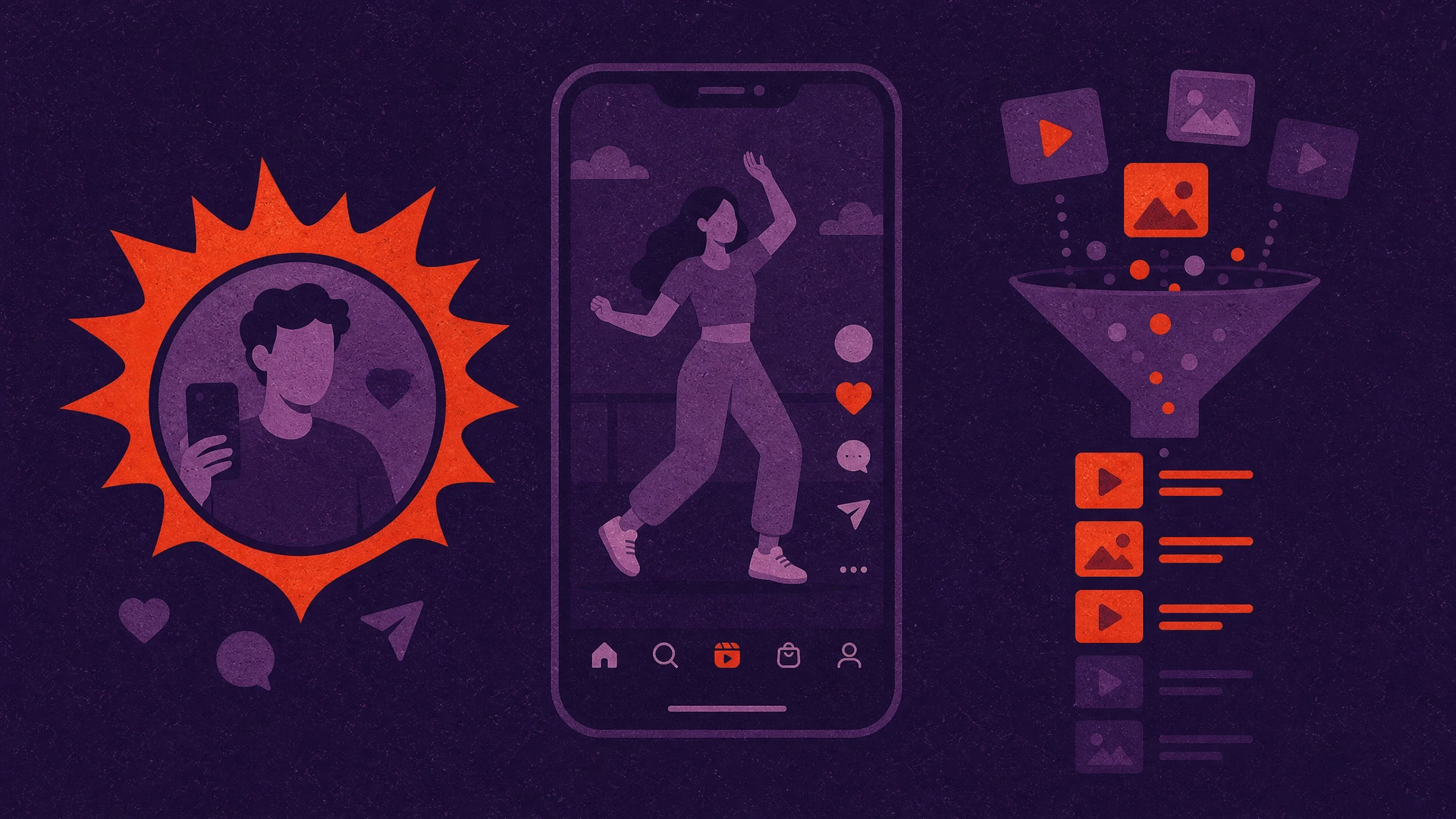
This is not a bug. It is a deliberate policy change. Instagram now separates two things that used to be the same: whether your content is allowed on the platform, and whether it will be recommended to new audiences. You can be fully compliant and still be invisible.
- 1Instagram now distinguishes 'policy compliance' from 'recommendation eligibility' — you can follow all the rules and still be invisible.
- 2Aggregator accounts that mostly repost others' content are no longer recommended in Explore.
- 3Original photos and carousels now receive explicit priority in Instagram's recommendation algorithm.
- 4Cross-platform repurposing — posting the same video to Instagram, TikTok, and Facebook simultaneously — is now a liability.
- 5The only sustainable solution is consistent, platform-native original content created specifically for Instagram.
Instagram's Quiet Algorithm Overhaul
Meta's Transparency Center documentation, analyzed in a July 5, 2026 study, confirmed the structural change. Instagram now operates with two separate eligibility systems running in parallel. The first is policy compliance: does this content violate Instagram's Community Guidelines? The second is recommendation eligibility: should this content be shown to people who don't already follow this account?
These two systems used to be effectively the same. If your content was allowed, it was eligible to be recommended. That is no longer true. A post can be fully compliant — no hate speech, no spam, no copyright violations — and still be excluded from Explore, Reels recommendations, and the Suggested Posts feed. The exclusion is not a punishment. It is simply the algorithm's assessment that the content is not worth recommending to new audiences.
Recommendation Eligibility vs. Policy Compliance
The distinction matters enormously for small businesses. Most social media advice focuses on avoiding policy violations: don't use banned hashtags, don't post misleading content, don't buy followers. That advice is still correct, but it is no longer sufficient.
Instagram's recommendation system now evaluates content on a different set of criteria. Aggregator accounts — accounts that primarily repost content created by others — are explicitly excluded from Explore recommendations. This includes businesses that share memes, industry news articles, motivational quotes from other creators, or any content they did not originate themselves.
The documentation also confirms that original photos and carousels now receive explicit priority in the recommendation algorithm. Not just equal treatment — priority. Instagram is actively pushing original visual content created by the account posting it.
"You can be fully compliant with every Instagram policy and still be invisible to new audiences. Compliance and recommendation eligibility are now two separate systems."
— Meta Transparency Center, July 2026The Repost Problem
For small businesses that have relied on reposting industry content, sharing viral posts, or curating content from other accounts, this change is significant. That strategy — which was a legitimate and common approach as recently as 2024 — is now actively penalized in the recommendation system.
The algorithm's logic is straightforward: Instagram wants its recommendation engine to surface original creators and original content. An account that primarily reposts others' work is not creating value for the platform's discovery ecosystem. It is extracting value from it. The new system reflects that judgment.
This does not mean you can never share others' content. It means that if the majority of your posting activity consists of reposts, your account will be treated as an aggregator and excluded from recommendations.
What 'Original Content' Actually Means on Instagram in 2026
Instagram's definition of original content is more specific than it might appear. It is not simply content that you created — it is content that was created natively for Instagram, by you, and has not been published elsewhere first.
This has three practical implications. First, content exported from TikTok with a TikTok watermark is explicitly penalized — this has been true for several years, but the penalty has increased. Second, content that is identical across multiple platforms — the same video posted to Instagram, Facebook, LinkedIn, and TikTok on the same day — is now evaluated as cross-platform repurposing, which reduces recommendation eligibility. Third, stock photography and generic graphic templates are treated as low-originality content and receive less distribution than photos and videos created specifically for the account.
The Cross-Platform Trap
The cross-platform repurposing issue deserves particular attention because it is so widespread. Most small businesses — and many agencies — use a content calendar that produces one piece of content and distributes it everywhere simultaneously. It is efficient. It is also now a liability on Instagram.
Instagram's algorithm can identify when content has been published on other platforms before being posted to Instagram. It can detect TikTok watermarks, YouTube thumbnails, and other platform-specific artifacts. And it now treats content that appears to have been created for another platform first as lower-priority for recommendations.
The practical implication: if you are creating content for Instagram, it should be created for Instagram specifically. The aspect ratio, the caption style, the visual language, and the timing should all be native to the platform.
How to Audit Your Last 60 Days
Before changing your content strategy, it is worth understanding where you currently stand. Pull your Instagram Insights for the past 60 days and look at three metrics: reach from non-followers, Explore impressions, and Reels plays from non-followers. If all three are significantly lower than they were 90 days ago, you are likely experiencing the recommendation eligibility impact.
Next, look at your last 30 posts and categorize each one: original photo or video created specifically for Instagram, original graphic or carousel created by your team, reposted content from another account, cross-platform content published elsewhere first, or stock photography. If more than 30% of your posts fall into the last three categories, your recommendation eligibility is almost certainly being suppressed.
The Case for On-Site Content Creation
The only sustainable solution to Instagram's new recommendation system is consistent, original, platform-native content. And for most small businesses, the most effective way to produce that content is to have someone create it at your location.
This is not about posting more frequently. It is about the quality and authenticity of what you post. A photo taken at your actual business location, showing your actual team or products or customers, is exactly the kind of original content Instagram's algorithm is designed to reward. It cannot be replicated by a stock photo library. It cannot be produced by a content calendar that repurposes the same asset across six platforms.
The businesses that are growing on Instagram in 2026 are the ones producing original content consistently — and the most effective way to do that consistently is to have a dedicated content creator who shows up at your location, understands your brand, and creates content that is genuinely native to your business.
We create original content at your location. Every month.
Igniter Digital is the only agency in the U.S. that sends a photographer and content creator to your location as part of your managed social media service. No stock photos. No reposts. No recycled graphics. Original, platform-native content that Instagram's algorithm is designed to reward.
See how it works