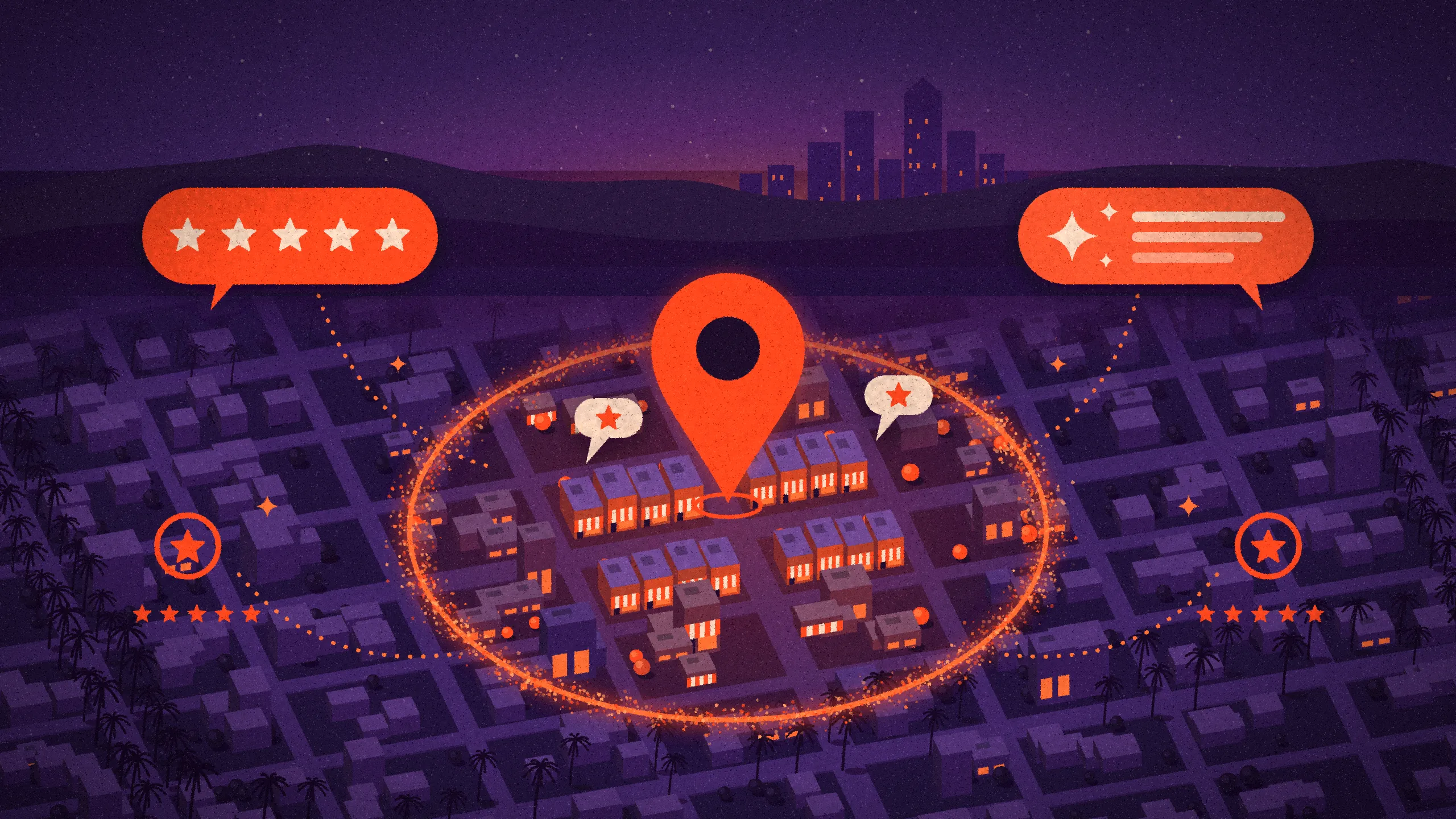

In our Los Angeles local SEO guide, we argued that LA is won neighborhood by neighborhood. Reviews are how that argument gets settled. In a metro where every Map Pack slot has a dozen credible contenders within two miles, your review profile is usually the tiebreaker: for Google's algorithm, for the AI assistants now making recommendations, and for the human thumb hovering between you and the place down the block.
And the rules just changed. This year's Local Consumer Review Survey from BrightLocal, the industry's longest-running study of how people actually use reviews, documented one of the sharpest shifts in expectations in its sixteen-year history. Here's what it found, and what an LA business should do about it.
"Your 300 reviews from the 2010s are archaeology. Your 15 from this quarter are marketing."
The new math of reviews
Four numbers every LA owner should know:
- *97% of consumers read reviews, and 41% now always read them* before choosing a business, up from 29% just last year. Reviews aren't one input anymore; for a plurality of your market, they're a mandatory checkpoint.
- 31% of consumers now only use businesses rated 4.5 stars or higher, nearly double last year's 17%, and more than two-thirds require at least 4.0. In review-saturated LA, where nearly every competitor clears 4 stars, the effective bar sits higher than almost anywhere.
- Old reviews don't count. Recency and steady velocity now matter more than lifetime totals, both to consumers and to ranking systems. Your 300 reviews from the 2010s are archaeology; your 15 from this quarter are marketing.
- 45% of consumers now ask AI tools for local recommendations, up from 6% a year ago, making AI the third-biggest recommendation source behind Google and Facebook. AI assistants build those recommendations largely by reading reviews at scale. Your reviews are no longer just displayed; they're source material being synthesized into answers you'll never see.
The LA reputation playbook
1. Build the machine, not the campaign
One-off review pushes produce exactly the burst-then-silence pattern that algorithms now discount. What works is a system wired into operations: an automatic text or email with your direct Google review link within 24 hours of every job, sale, or appointment; a QR code at the counter; a sentence your staff actually says. In LA specifically, timing beats volume. Ask at the moment of delight (the fresh cut, the finished install, the completed detail), because that's when customers write the specific, enthusiastic reviews that matter most (see #3).
2. Respect the 4.5 threshold, and the law
If you're below 4.5, the math is your roadmap: calculate how many five-star reviews move your average, then let the machine grind toward it week over week. What you must not do is shortcut it. The FTC's consumer review rule now carries real enforcement: buying, faking, or incentivizing reviews risks penalties, and consumers overwhelmingly say fake-review users should be punished. Review gating, where only happy customers get the review link, is also off-limits; it violates Google's review policies and puts your Business Profile at risk. In a market as review-literate as Los Angeles, getting caught is a business-ending event, not a slap on the wrist.
One legitimate accelerator: ask your regulars. Loyal customers who've never reviewed you are your largest untapped reserve, and their reviews tend to be the detailed, credible kind.
3. Coach for content without scripting it
Review text now works overtime: Google's AI summaries and assistant recommendations are built from the specific words in your reviews (here's how Google's AI reads your profile). "Great place!" is a wasted data point. "Best fade in Highland Park, easy street parking, Marco remembered my usual" is a ranking asset that mentions your neighborhood, your differentiators, and your staff. You can't write reviews for customers, but you can shape them honestly: ask "would you mention what service you had done?" in your follow-up, and watch specificity climb. In LA, reviews that name neighborhoods and parking realities are disproportionately valuable. They're exactly what locals search for and exactly what AI answers quote.
4. Reply like a person, fast, to everything
Review responses are now judged by everyone: Google's systems, AI summarizers, and consumers, half of whom are put off by generic copy-and-paste replies. The standard is every review answered within a few days, in a recognizably human voice, with negative reviews handled in two moves: a non-defensive public reply, then the fix taken offline. AI-suggested replies are showing up inside review dashboards; use them as drafts if you like, but edit every one. The moment your replies sound automated, they subtract trust instead of adding it.
5. Spread beyond Google, because your customers already have
The average consumer now consults six different review sites before deciding. Google still leads, but its share of local recommendations dropped from 83% to 71% this year, while Apple Maps usage nearly doubled, from 14% to 27%. That's meaningful in an iPhone-dense, CarPlay-driving city, and Yelp retains unusual weight in LA dining, beauty, and services. Add Instagram and TikTok, where a growing share of customers check what amounts to video reviews.
You don't need to dominate all six. You need a claimed, accurate, minimally active presence on each one relevant to your category, because cross-platform consistency is precisely what AI assistants verify before they'll recommend you. Start with your Google Business Profile, then mirror it everywhere else.
Frequently asked questions
How many reviews do I need to compete in LA?
Fewer than you think, fresher than you have. A 4.7 with steady weekly reviews beats a 4.4 with a thousand stale ones, in the algorithm and in the survey data.
Should I respond to a review I think is fake?
Yes. Reply calmly and factually, for the audience reading it, while flagging it through the platform. Never accuse; state what your records show.
Can I ask customers to update or remove a bad review after fixing the problem?
You can ask, gently, after genuinely resolving it. Many will. Never offer anything in exchange; that crosses the same line as buying reviews.
References
A review system is an operations project, and running it is literally our job.
Igniter Digital's managed SEO and managed reputation build and run the whole engine (asks, monitoring, responses, and multi-platform presence) for Los Angeles small businesses. 17+ years, no contracts. Get Your Free Local Visibility Audit and we'll benchmark your ratings, velocity, and AI visibility against the competitors in your neighborhood.
Get Your Free Local Visibility Audit