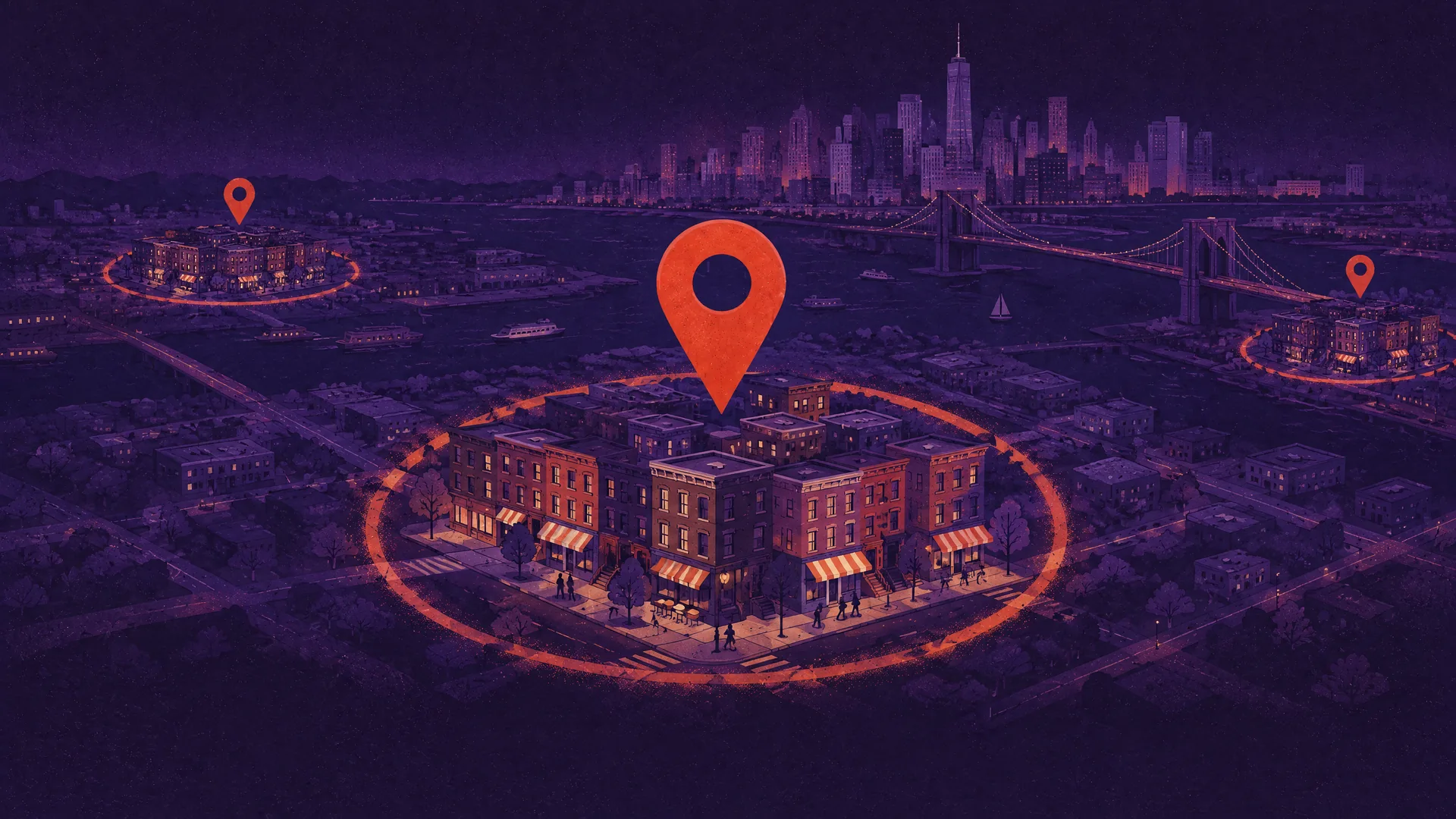
New York City is the most competitive local search market in the country, and also the most misunderstood. Business owners look at 8.5 million residents and assume they need a citywide strategy to matter. The opposite is true. NYC's density means Google's local algorithm operates at the smallest geographic scale anywhere in America: not the city, not even the borough, but the walkshed, the fifteen-minute radius a New Yorker will actually travel for your kind of business.
Nobody in Park Slope is taking the train to the Upper West Side for a barber. Google knows this and localizes accordingly. Which means the real question isn't "how do I rank in New York?" It's "how do I own my corner of it?" A dominant position in one neighborhood here is a bigger market than an entire city elsewhere. Park Slope alone has more residents than many county seats.
What makes NYC different
Proximity operates at walking scale. In most metros, the Map Pack draws from a several-mile radius. In Manhattan and brownstone Brooklyn, it can effectively narrow to blocks. This compresses the competitive field enormously: you're not competing with every NYC business in your category, you're competing with the eight of them within walking distance. That's a winnable fight.
Borough and neighborhood identity drive queries. New Yorkers search "dentist Astoria," "CPA Williamsburg," "vet UWS," and each of those markets has distinct demographics, price points, and languages. Outer-borough neighborhoods (Astoria, Flushing, Jackson Heights, Bay Ridge, Sunset Park) add a multilingual dimension: substantial search volume happens in Spanish, Chinese, Korean, Russian, and more, with far thinner optimized competition.
Discovery is fragmented across platforms. NYC leans harder than anywhere on the full discovery stack: Google, Apple Maps (an iPhone city on foot), Yelp, neighborhood Reddit and Facebook groups, local newsletters, and now AI assistants, where "best pizza in my neighborhood" queries get answered with specific names. The visibility gap is stark: research this year shows only a small percentage of businesses appear in AI recommendations even while a third appear in traditional local results.
Foot traffic and search feed each other. Your storefront generates searches ("that flower shop on Court Street") and your search presence generates walk-ins. Branded local search behavior is stronger in NYC than anywhere, which makes brand-name clarity and consistency unusually valuable.
The NYC local SEO playbook
1. Define your walkshed and own it completely
Draw your realistic customer radius, for most storefront businesses, 10–20 minutes on foot or one or two subway stops. That's your market. Every keyword, page, review, and citation should reinforce it. Winning "hardware store Greenpoint" completely beats being the 40th result for "hardware store NYC."
2. Max out the Google Business Profile, with NYC specifics
The universal rules apply at full force; profile signals drive roughly a third of Map Pack rankings, primary category is the top factor, review recency beats totals, and accurate hours are now a ranking input. NYC adds its own required fields: exact address with floor or suite, transit context in your description ("half a block from the Bedford L"), and up-to-the-minute holiday hours. In a city where people check before walking over, wrong hours don't just lose the sale, they generate the angry review that costs you the next ten.
3. Put your cross streets on your website
NYC customers and algorithms both need micro-location clarity: neighborhood name, cross streets, nearest train lines, what you're next to. Studies of how AI assistants pick local recommendations show explicit place association is one of the strongest signals. The businesses that get named are the ones whose location is unmistakable from their web presence. "Cobble Hill florist at Court & Baltic, two blocks from the F at Bergen" is optimization, not decoration.
4. Treat reviews as your densest ranking asset
In a market where every Map Pack slot has real competition, review velocity is often the tiebreaker. Build a relentless, polite ask into your operation, respond to everything (in the reviewer's language where relevant, a real edge in multilingual neighborhoods), and let reviews accumulate neighborhood keywords naturally. And don't ignore Yelp here; it retains real influence on NYC decisions and feeds the third-party validation layer AI systems check.
5. Get into the neighborhood's information ecosystem
NYC prominence is built neighborhood by neighborhood: local press (Brooklyn Paper, amNY, Patch, the neighborhood blogs and newsletters that New Yorkers actually read), BIDs (Business Improvement Districts; join yours, the citation and the network both pay), merchant associations, street fairs, community boards. Each mention is a brick in the authority wall that decides both Map Pack rankings and AI citations.
6. Serve multilingual neighborhoods in their languages
If your customer base searches in Spanish, Chinese, Korean, or Russian, dedicated pages in those languages (properly tagged, genuinely written) open a second, less-contested front, the same structural advantage we detailed for Miami's Spanish-language market, multiplied across NYC's linguistic map.
Frequently asked questions
Is local SEO worth it in a market this competitive?
It's worth more here, because the geographic compression means you're only ever competing with your immediate neighbors, and the customer density behind each ranking position is the highest in the country.
How much does local SEO cost in NYC?
Typically from several hundred to a few thousand dollars monthly. Manhattan professional services and anything in legal or medical run premium; outer-borough neighborhood businesses are far more accessible than owners assume.
Should I target my borough or my neighborhood?
Neighborhood first, always. Borough-level visibility is what happens after you've stacked several neighborhood wins, not where you start.
Want to know if you're winning your walkshed?
Igniter Digital provides managed SEO, website design, and social media for small businesses, 17+ years of results, no contracts. **Get Your Free Local Visibility Audit** and we'll show you exactly how your neighborhood sees you on Google, Apple Maps, and the AI assistants your customers are already asking.
Get Your Free Local Visibility Audit