
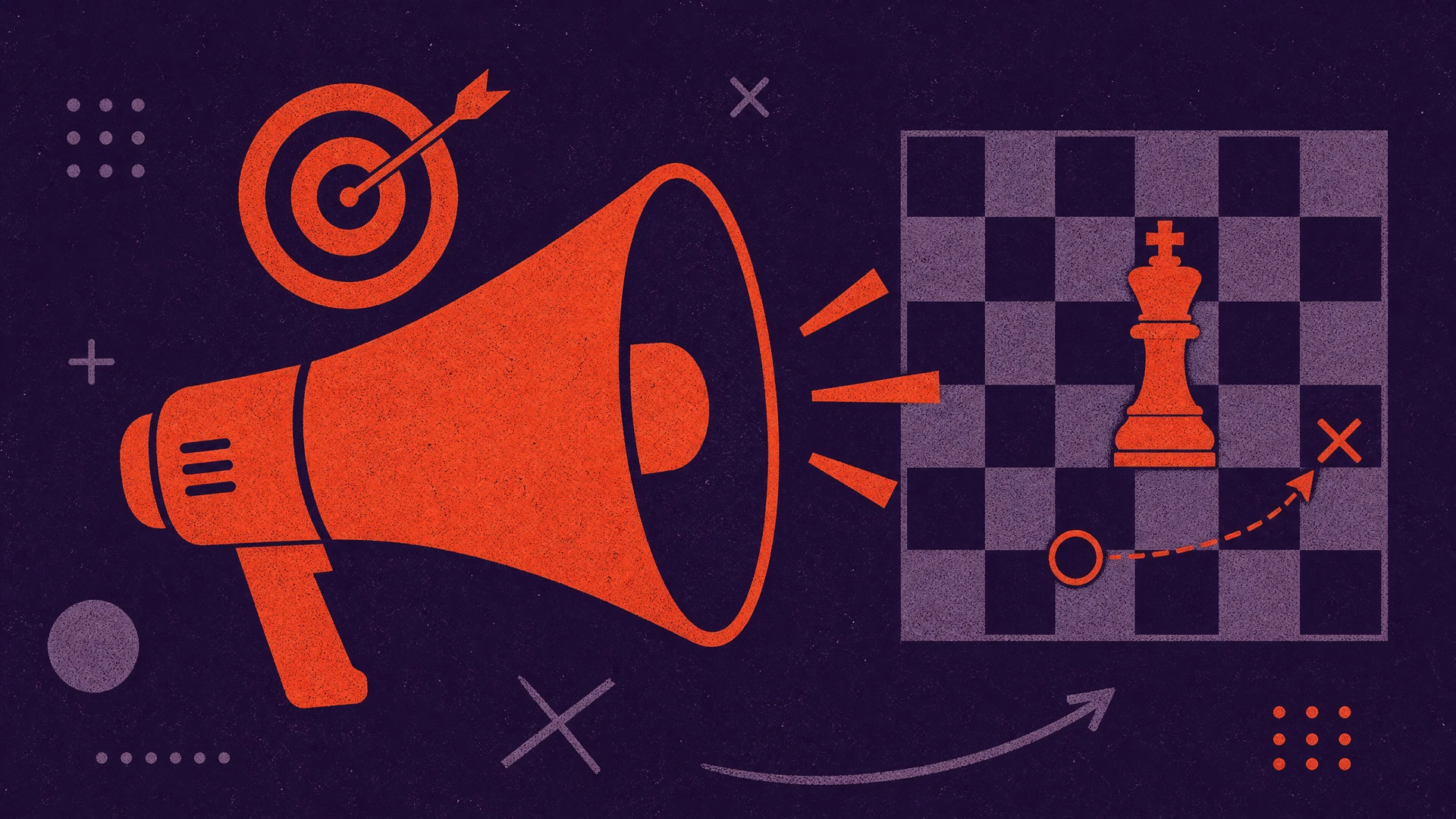
It's the most common trap in small business ownership. A new entrepreneur launches a company, builds a product, or opens a storefront, and immediately asks the question: "How do I market this?" They rush to Facebook Ads. They print flyers. They launch a TikTok account. They pour money, time, and energy into tactics, hoping that sheer volume of activity will translate into revenue. And when the phone doesn't ring and the inbox stays empty, they conclude that "marketing doesn't work for my business." The problem isn't the marketing. The problem is that the marketing was deployed before a strategy was established. Marketing is a megaphone. Strategy is what you say into it. If you don't know who you're talking to, what problem you solve, and why you're the best choice to solve it, handing you a louder megaphone will only broadcast your confusion to a wider audience. In business, marketing must always follow strategy.
The Difference Between Strategy and Tactics
To understand why strategy must come first, we have to separate it from tactics. Tactics are the actions you take. A billboard is a tactic. A social media post is a tactic. A networking event, a discount code, an email newsletter, and a Google Ad are all tactics. They are the vehicles used to deliver a message. Strategy is the foundation that determines which tactics you should use, what message they should carry, and who they should be aimed at. Strategy answers the fundamental questions of your business existence: Who is your ideal customer? What specific problem do they have? How does your product or service solve that problem better than the alternatives? What is the core message that communicates this value? When you lead with tactics, you're guessing. You're throwing darts in the dark, hoping one hits the bullseye. When you lead with strategy, you turn the lights on.
The Cost of Tactical Marketing
Imagine a local landscaping company that decides they need more business. The owner decides to invest $1,000 in Facebook Ads because he heard that "everyone is on Facebook." He creates an ad that says, "Call us for all your landscaping needs! Best prices in town!" The ad runs. A few people click. No one calls. The $1,000 is gone. This is tactical marketing. The owner skipped the strategy phase. If he had paused to develop a strategy, he might have realized that his most profitable customers aren't people looking for the "best prices." His most profitable customers are busy, dual-income homeowners who value reliability and a pristine lawn but have zero time to do it themselves. With that strategy in mind, the tactic changes entirely. Instead of a generic Facebook Ad promising cheap prices, he might launch a targeted direct mail campaign in high-income neighborhoods. The message shifts from "Best prices in town" to "Reclaim your weekends. Professional, reliable lawn care for busy homeowners." The service is the same. The difference is the strategy.
Defining Your Strategy
Building a marketing strategy doesn't require an MBA or a fifty-page document. For most small businesses and local entrepreneurs, a solid strategy can be boiled down to three core pillars: Audience, Differentiation, and Messaging.
1. Know Your Audience (Narrow the Focus)
You can't be everything to everyone. The fear of missing out on potential customers often leads businesses to cast too wide a net. But when you try to speak to everyone, you end up resonating with no one. Identify your best customers. Who are they? What do they care about? What are their pain points? A premium coffee shop isn't selling coffee to everyone who drinks coffee; they are selling an experience, a status symbol, and a comfortable workspace to people who value those things over a cheap cup of drip coffee from a gas station. Define your audience so clearly that you can picture them in your mind.
2. Define Your Differentiation (Why You?)
Why should someone choose your business over the competitor down the street or the cheaper option online? "Quality" and "good customer service" are not differentiators; they are baseline expectations. True differentiation comes from solving a specific problem in a unique way. Maybe you're the fastest. Maybe you're the most specialized. Maybe you offer an unmatched guarantee. Find the one thing you do better than anyone else and make it the cornerstone of your business identity.
3. Craft Your Message (Keep It Simple)
Once you know who you are talking to and why they should choose you, you must distill that into a clear, compelling message. Customers do not buy products; they buy solutions to their problems. Your messaging should focus entirely on how your business improves the customer's life. Remove the industry jargon. Stop talking about the features of your product and start talking about the benefits. If you sell mattresses, you aren't selling foam and springs; you're selling a good night's sleep and a pain-free morning.
The Filter for Every Decision
When you have a clear strategy, marketing becomes significantly easier. Your strategy becomes a filter for every business decision you make. Should you be on TikTok? If your strategy dictates that your ideal audience is retired homeowners looking for bathroom remodels, the answer is no. You don't have to debate it; the strategy makes the decision for you. Should you offer a 50% off discount? If your strategy is built around being a premium, high-end service provider, discounting devalues your brand. Again, the strategy provides the answer. Strategy eliminates the shiny object syndrome that plagues so many small business owners. It gives you the confidence to say "no" to the wrong opportunities so you can double down on the right ones.
"Marketing is not magic. It cannot fix a broken product, and it cannot overcome a lack of direction. It is simply an amplifier."
— James TaylorThe Igniter Mindset
Before you spend another dollar on advertising, before you write another social media post, and before you print another business card, stop and define your strategy. Figure out exactly who you're serving, what problem you're solving, and why you're the best choice. Once the strategy is clear, the tactics will reveal themselves. Marketing follows strategy. Always.
Ready to build a strategy that actually works?
Igniter Digital helps small businesses define their marketing strategy and execute it end-to-end — no long-term contracts, no guesswork.
Get a Free ConsultationContinue the Igniter Manifesto
Each idea in the series builds on the last. Continue with the themes that make the current principle more useful in practice.