
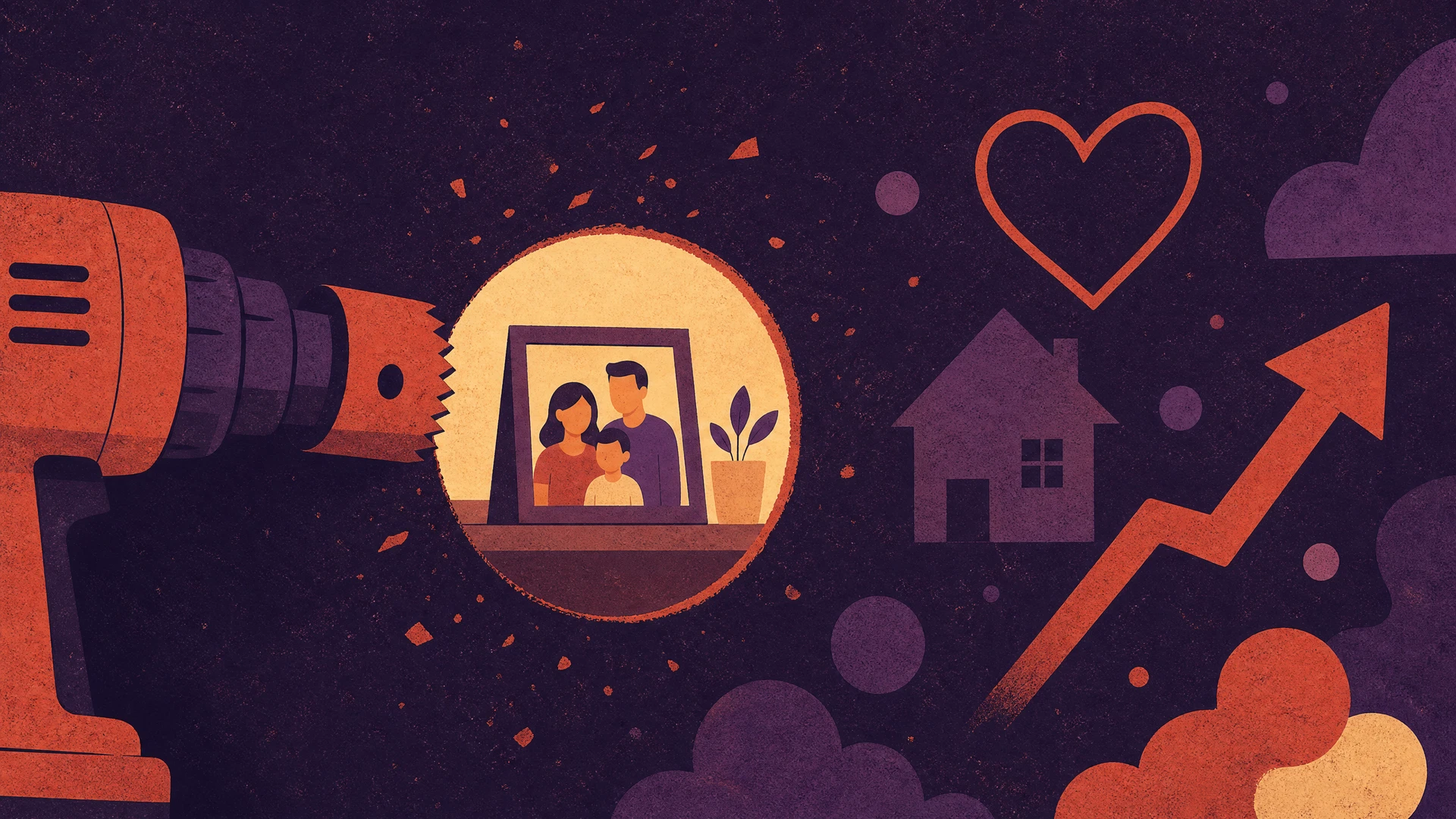
Nobody buys a drill because they want a drill.
They buy it because they need a hole in the wall. And behind that hole is a shelf. And on that shelf will sit a framed photo of their kids, or a row of books they're proud of, or a piece of art that finally makes the living room feel like home.
The drill is the transaction. The feeling is the reason.
This distinction — between what someone buys and why they buy it — is one of the most important things a small business owner can understand. Because if you're marketing the drill when your customer is imagining the shelf, you're having the wrong conversation entirely.
People buy feelings, not products
Every purchase, no matter how rational it appears on the surface, is ultimately driven by emotion. This isn't a cynical observation — it's simply how human beings are wired. We make decisions with the emotional centers of our brain and then use logic to justify those decisions afterward.
The person who buys the premium accounting software isn't buying rows and columns. They're buying peace of mind. The confidence that their books are right, that tax season won't be a catastrophe, that their business is on solid financial ground. The software is the vehicle. The relief is the destination.
The homeowner who hires the more expensive landscaping company isn't paying extra for grass. They're paying for the feeling of pulling into their driveway at the end of a long day and seeing something that makes them proud. They're buying a version of themselves that has their life together.
When you understand this, your marketing transforms. You stop describing what you sell and start describing how it feels to own it.
The six core buying motivations
While every customer is unique, most purchasing decisions can be traced back to one or more of six core motivations. Understanding these isn't about manipulation — it's about empathy. It's about understanding what your customer actually cares about so you can speak to it honestly.
1. The desire to gain something. More revenue, more time, more status, more comfort, more freedom. Customers are constantly looking for ways to improve their situation. If your product or service moves them toward something they want, that's a powerful motivator.
2. The fear of losing something. Loss aversion is one of the most well-documented forces in human psychology. People are more motivated to avoid a loss than to achieve an equivalent gain. A business owner who is afraid of losing customers to a competitor is more likely to act than one who is simply hoping to grow. If your business protects something your customer values — their time, their money, their reputation — lead with that.
3. The need for belonging. Human beings are social creatures. We buy things that signal membership in a group we want to belong to. The local coffee shop that has become a neighborhood institution isn't just selling coffee; it's selling a sense of community and identity. People who buy there are saying something about who they are.
4. The desire for convenience. Time is the one resource that can't be replenished. Anything that saves time, reduces effort, or removes complexity has enormous value. If your business makes someone's life easier, that's not a minor benefit — it's often the primary reason they'll choose you.
5. The need for certainty. Buying anything involves risk. The customer is exchanging money — something they have — for a result — something they hope to receive. Anything that reduces the perceived risk of that exchange lowers the barrier to purchase. Guarantees, reviews, credentials, and transparent processes all serve this need.
6. The desire for self-expression. People buy things that reflect who they are or who they want to become. This is why two people with identical needs will choose different products. One buys the practical sedan; the other buys the vintage truck. The choice is never purely functional. It's always, in part, a statement.
The question your marketing must answer
Every customer, before they make a purchase, is asking a version of the same question: "What's in this for me?"
Not for your business. Not for your team. For them.
This sounds obvious, but most small business marketing fails this test completely. It talks about years of experience, family-owned history, and commitment to quality — all of which are about the business, not the customer. The customer doesn't care about your story until they believe you understand theirs.
Before you write a single word of marketing copy, answer this question from your customer's perspective: "If I buy this, my life will be better because..."
Fill in that blank with something specific and emotionally honest, and you have the foundation of a message that will actually connect.
Why logic alone won't close the sale
There's a temptation, especially among business owners who are deeply knowledgeable about their industry, to lead with facts. Specifications. Certifications. Processes. Data.
Facts matter. But facts alone rarely move people to act.
Consider two ways of describing the same home security system. The first: "Our system features 1080p HD cameras, 128-bit encryption, and a 99.7% uptime guarantee." The second: "You should be able to leave for vacation without spending the whole trip wondering if your home is safe."
The first speaks to the product. The second speaks to the person. Both are true. Only one creates a feeling.
Logic gives customers permission to buy. Emotion gives them the reason to. You need both — but you have to earn the emotional connection first.
"Stop selling products and start solving problems. Stop interrupting people and start speaking directly to something they already care about."
— James TaylorThe Igniter mindset
The next time you sit down to write a social media post, update your website, or put together any kind of marketing, resist the urge to start with what you offer. Start instead with who your customer is and what they're really trying to solve, feel, or become.
Ask yourself: what's the hole in the wall they're trying to make? What's the shelf they're imagining? What's the photo they want to hang?
When you understand why people buy, you stop selling products and start solving problems. You stop interrupting people and start speaking directly to something they already care about.
That's the difference between marketing that gets ignored and marketing that gets results.
- 1Identify which of the six buying motivations your best customers are actually responding to — ask them directly, or look at the language they use in reviews.
- 2Rewrite your homepage headline to answer "If I buy this, my life will be better because..." from the customer's perspective.
- 3Lead with the emotional outcome in your marketing, then follow with the logical proof. Earn the connection first, then give them permission to act.
- 4Next week: Trust Is Your Greatest Marketing Asset — the single most valuable thing your business can build, and the one no competitor can copy.
Ready to build marketing that actually connects?
Igniter Digital helps small businesses develop messaging that speaks to what customers actually care about — then builds the website, SEO, and social media presence to put that message in front of the right people.
Start the ConversationContinue the Igniter Manifesto
Each idea in the series builds on the last. Continue with the themes that make the current principle more useful in practice.
Marketing Is Solving Problems
Turn an understanding of why people buy into helpful messaging that solves what matters to them.
Trust Is Your Greatest Marketing Asset
Learn how trust reduces the risk customers feel when they are ready to make a decision.