

For years, the goal of online marketing was simple: get your business to show up when someone searches for what you sell. You picked your keywords, built your pages, earned your rankings, and waited for the phone to ring.
But search is changing — and it's changing faster than most business owners realize.
People are increasingly asking AI tools questions instead of typing keywords into Google. They're asking ChatGPT which contractor to hire, which accountant to trust, which plumber shows up on a Sunday. And those AI tools aren't just returning a list of links. They're forming an opinion about which businesses are the real authorities on a topic.
That creates a different challenge than ranking for a keyword.
You don't just need to show up for one search. You need to become the business AI associates with an entire topic.
A new study from Semrush and researcher Kevin Indig of Growth Memo analyzed 1,094 topic categories, more than 50,000 brands, and over 600,000 citations tracked in ChatGPT from January through June 2026. What they found has real implications for every small business owner trying to grow online — and most of it is genuinely good news.
The Big Finding: Most Topics Are Still Wide Open
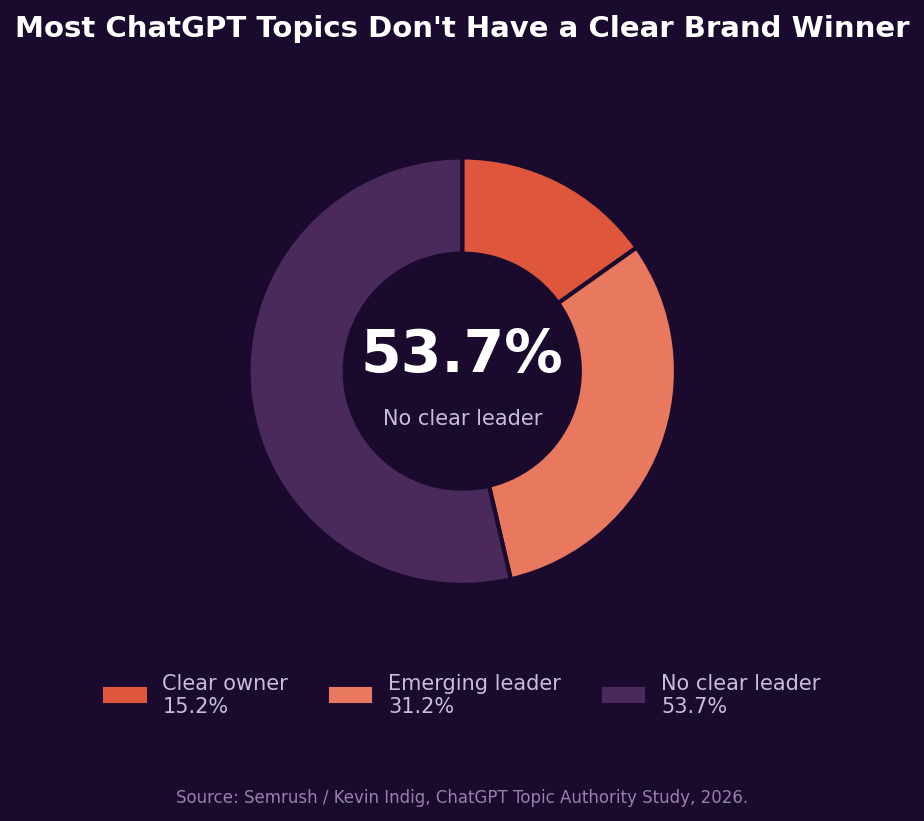
Here's the headline from the research: 53.7% of the topics studied had no clear brand owner in ChatGPT.
Think about what that means. More than half of the subject areas people are actively asking AI about — from "best roofing contractor" to "small business payroll software" to "what to look for in a financial advisor" — don't have a single business that ChatGPT consistently recommends above everyone else.
The full breakdown from the Semrush study:
- 15.2% of topics had a clear owner (one brand appearing in at least 4 of 5 related prompts, with a meaningful lead over the runner-up) - 31.2% had an emerging leader (one brand showing up in at least 3 prompts, but without a commanding lead) - 53.7% were unsettled — no brand showed up consistently enough to be considered a leader at all
That 85% figure — the topics without a clear owner — is the opportunity. The race to become the go-to authority in your category is still very much open in most industries.
Showing Up Once Isn't the Same as Being the Authority
This is where a lot of businesses misread the situation.
You might have a blog post that shows up in a ChatGPT answer. You might have been mentioned once or twice when someone asked a question in your industry. That's a start — but it's not the same as owning a topic.
The Semrush study defined a "clear owner" as a brand that appears in at least four out of five related prompts on a topic, with a meaningful lead over the next closest competitor. Not just one question. Not just occasionally. Consistently, across the full range of questions a potential customer might ask.
Think about a Nashville roofing company. A potential customer researching a roof replacement isn't asking just one question. They're asking several:
- How much does a new roof cost in Nashville? - How long does a roof last? - Should I repair or replace my roof? - What roofing materials are best for Tennessee weather? - How long does a roof replacement take? - What does homeowners insurance cover for roof damage? - How do I choose a roofing contractor? - What questions should I ask before hiring a roofer?
A business that has answered all of those questions — clearly, helpfully, and in a way that gets referenced by other sources — is building topical authority. A business that has one page optimized for "roofing company Nashville" is not.
The goal isn't to rank for a keyword. It's to become the business that is recognized as the authority on the entire subject of residential roofing in your market.
Traditional SEO Metrics Don't Tell the Whole Story
Here's where the research gets genuinely surprising — and where a lot of conventional wisdom starts to break down.
You'd expect that the businesses with the strongest SEO fundamentals would automatically win in AI search too. Higher domain authority, more organic traffic, stronger branded search volume — surely those things translate directly to ChatGPT visibility?
According to the Semrush study, they don't. Not reliably.
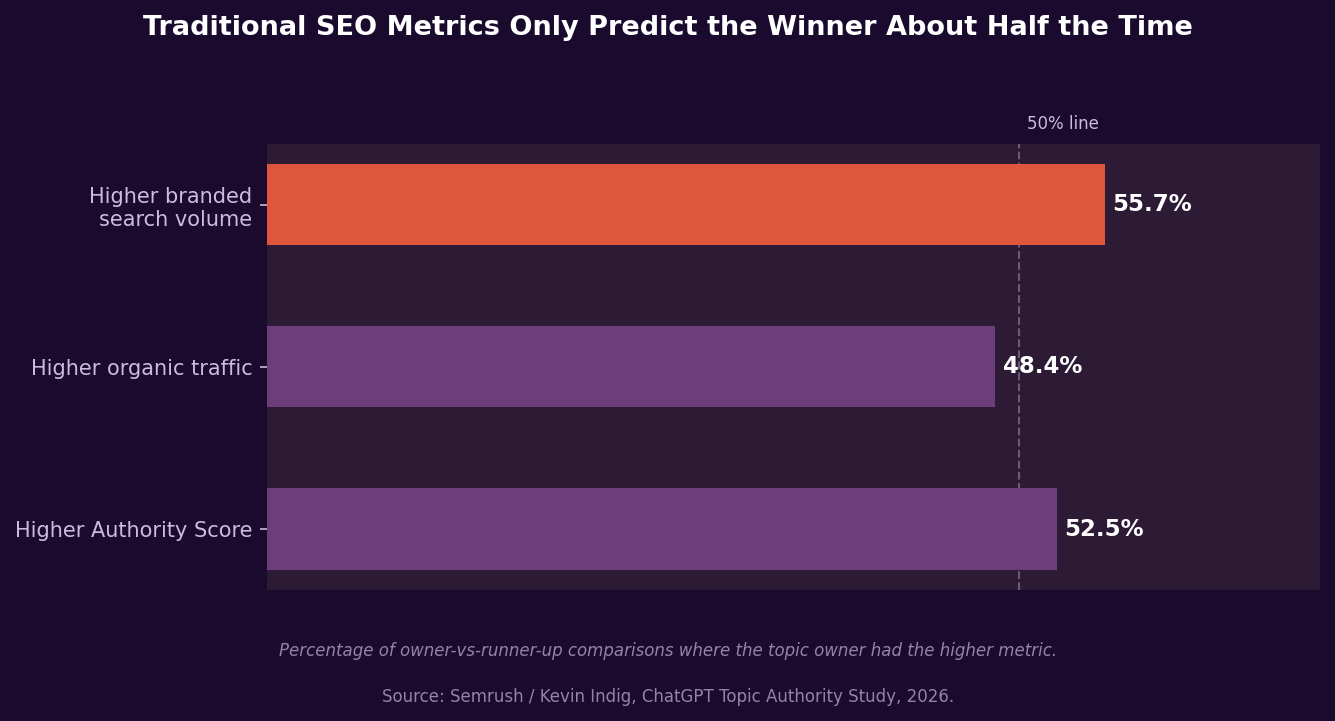
The researchers compared topic owners against their closest competitors on three standard SEO metrics:
- Higher branded search volume: The topic owner had more in only 55.7% of comparisons - Higher organic traffic: The topic owner had more in only 48.4% of comparisons - Higher Authority Score: The topic owner had a higher score in only 52.5% of comparisons
To put that in plain terms: in roughly half of the topics studied, the business that won in ChatGPT had less organic traffic, a lower authority score, or less branded search volume than the runner-up — and still won.
As Kevin Indig, the researcher who co-authored the study, put it: "Traditional SEO metrics aren't enough to explain who owns a topic. While they play their role, there's more to it."
This does not mean SEO is dead. Your website still needs to be well-built, fast, and optimized. Google rankings still matter enormously. But this research suggests that traditional SEO strength alone doesn't guarantee that AI tools will associate your business with a topic. Something else is also at work — and that something else is depth of topical coverage and the breadth of third-party signals that connect your brand to a subject.
The Most Popular Topics May Actually Be Your Biggest Opportunity
Here's something that runs counter to what most people expect.
In traditional Google search, the most popular keywords are the hardest to rank for. Big brands with big budgets dominate the top positions, and smaller businesses often have to compete for the long tail.
In AI search, the Semrush study found the opposite pattern.
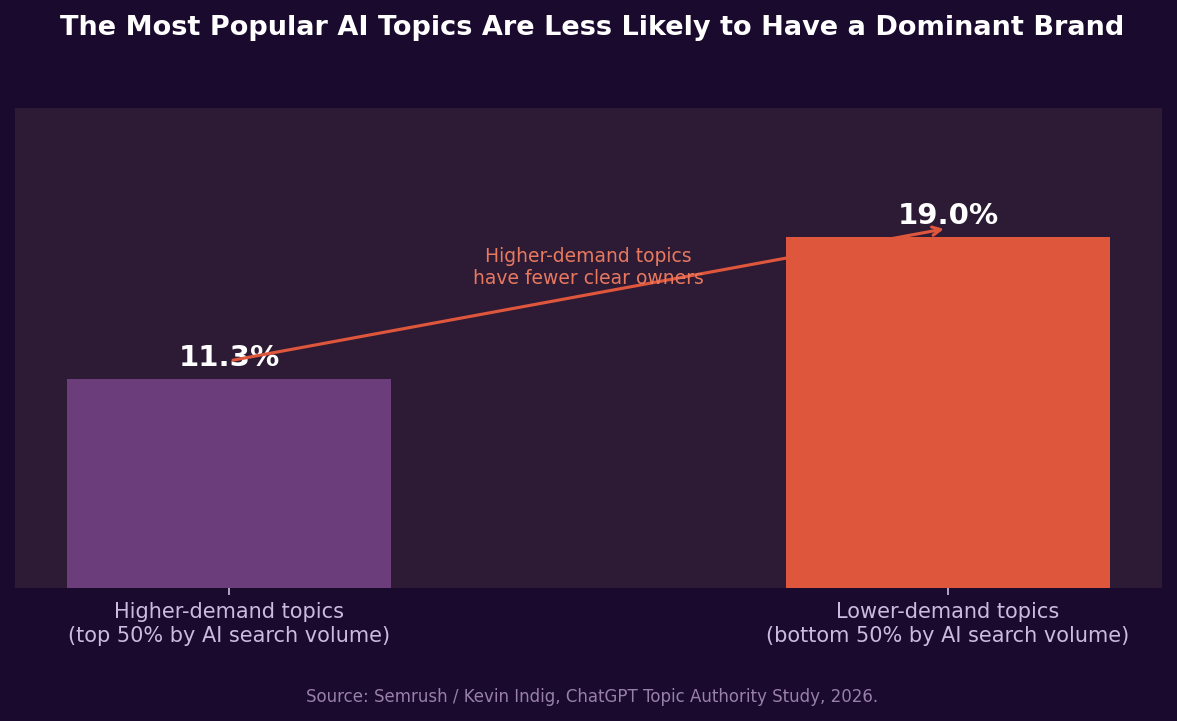
The researchers split the 1,094 topics into two groups: the higher-demand topics (the ones people ask about most in AI search) and the lower-demand topics (the ones asked about less frequently).
- Only 11.3% of higher-demand topics had a clear brand owner - 19.0% of lower-demand topics had a clear brand owner
The most popular topics — the ones that represent the vast majority of AI search volume — are actually less likely to have a dominant brand. The study notes that the top half of topics by demand accounts for 98% of the AI search volume in the sample. Almost every question being asked in ChatGPT lands in a topic without a clear winner.
Once You Own a Topic, You Tend to Hold It
Here's the flip side of the opportunity: once a business establishes clear topic authority, it tends to be sticky.
The Semrush study tracked topic leadership month over month from January through June 2026. Clear category owners — the businesses that had built a commanding lead — retained first place in 90.4% of month-over-month comparisons. That's a remarkably stable position.
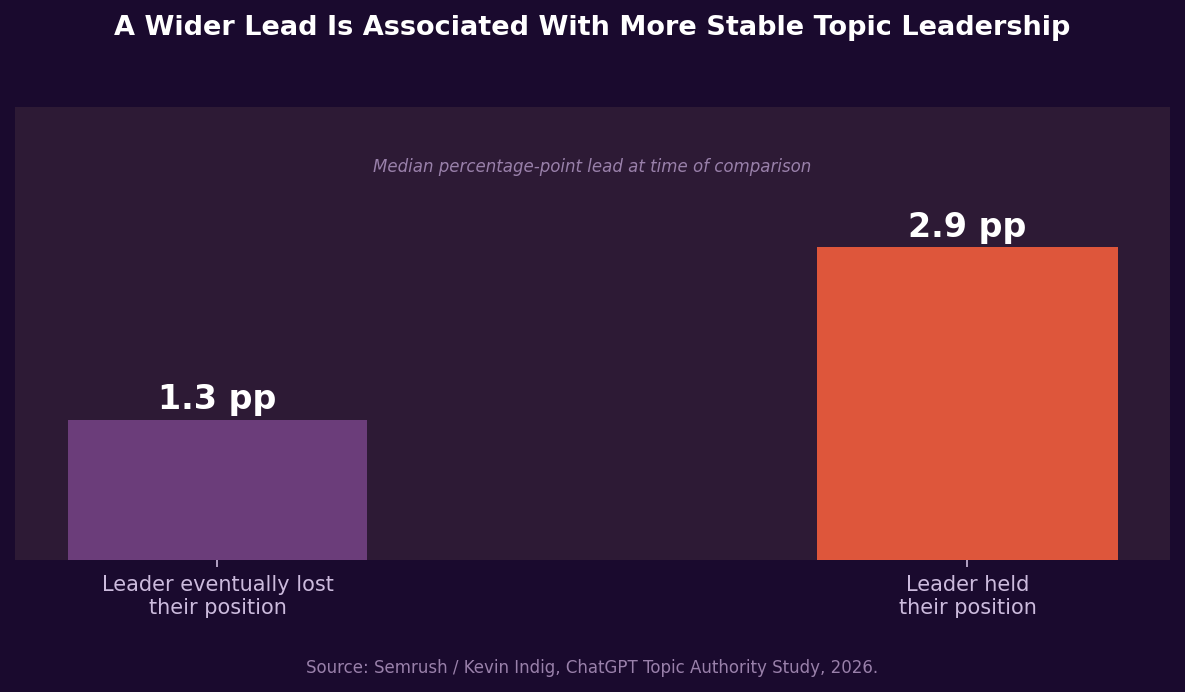
But the stability depends heavily on the size of the lead. The data tells a clear story:
- When a topic leader eventually lost their position, the median lead at the time was just 1.3 percentage points - When a topic leader held their position, the median lead was 2.9 percentage points
The practical implication: a narrow lead is fragile. A wide lead compounds. Businesses that establish a commanding position in a topic — through consistent content, strong mentions, and broad topical coverage — tend to hold that position even as competitors try to catch up.
This is why the window matters. The businesses that build topical authority now, while most categories are still unsettled, may find that position increasingly difficult for competitors to displace later.
Your Website Should Answer the Questions Your Customers Are Already Asking
The most actionable takeaway from this research is also the most straightforward: your website needs to answer the full range of questions your potential customers are asking — not just optimize for the one or two keywords you're targeting.
Go back to the roofing example. A business that has published genuinely helpful answers to all eight of those questions — in plain language, with real detail, updated regularly — is doing something fundamentally different from a business that has a homepage, a services page, and a contact form.
The same principle applies to every industry. A financial advisor who has answered "what's the difference between a Roth IRA and a traditional IRA," "when should I start saving for retirement," and "how do I find a financial advisor I can trust" is building topical authority. A plumber who has explained "how to know when a pipe needs replacing," "what causes low water pressure," and "how to prevent frozen pipes in winter" is doing the same thing.
This isn't about gaming an algorithm. It's about genuinely becoming the most useful resource in your category — which is exactly what AI tools are trying to surface when someone asks them a question.
Your managed website is the foundation of this effort. Every page, every FAQ, every piece of content is an opportunity to demonstrate that your business understands the problems your customers face and has the expertise to solve them.
It's Not Just About Your Website
One of the most striking findings in the Semrush study is the disconnect between website citations and brand mentions.
The researchers found that the brand most frequently mentioned by ChatGPT in its answers and the domain most frequently cited as a source were the same in only 21% of cases. In other words, ChatGPT often recommends a brand in its answer text while citing a completely different website as its source.
This matters for a practical reason: your visibility in AI search isn't determined solely by how well your own website performs. It's also shaped by how your business is talked about across the broader internet — in reviews, in industry directories, in news articles, in social media, in forums, in third-party publications.
A business that has strong local SEO — consistent business listings, active review profiles, mentions in local publications, a well-maintained Google Business Profile — is building the kind of distributed brand signal that AI tools draw from.
A business that only invests in its own website, without attention to how it's represented across the rest of the internet, is leaving a significant part of the picture incomplete.
"Don't just try to rank for a keyword. Become the business that is recognized as an authority on the problem you solve."
— James TaylorThe Businesses That Establish Authority Now May Have an Advantage Later
The Semrush study covered six months of data. That's a relatively short window, and AI search is still evolving rapidly. It would be a mistake to treat any of these findings as permanent laws.
But the directional signal is clear: topic ownership in AI search is currently up for grabs in most categories, and the businesses that move to establish it now are likely to benefit from the compounding effect the data describes.
The 90.4% retention rate for clear topic owners isn't a guarantee. But it does suggest that the businesses building wide leads today are creating positions that will be harder for competitors to displace tomorrow.
The window for establishing that lead may not stay open indefinitely. As more businesses recognize the importance of topical authority and invest in building it, the unsettled 53.7% will start to shrink.
The New Question Every Business Owner Should Be Asking
Most business owners are asking the wrong question about their online visibility.
The old question was: "What keywords am I ranking for?"
The better question is: "When a potential customer asks an AI tool about the problem I solve, does my business come up — and does it come up consistently, across all the related questions they might ask?"
If you don't know the answer to that question, you don't have a complete picture of your online visibility. You might be winning in traditional search while losing ground in AI search. Or you might have more opportunity in AI search than you realize, because the topic you compete in hasn't been claimed yet.
Either way, the answer to that question should be informing your marketing strategy right now.
AI Search Is Not Replacing SEO. It's Expanding the Game.
Let's be direct about something: AI search is not replacing Google. It's not making SEO irrelevant. The businesses that rank well in traditional search are still capturing enormous value from that visibility.
What this research suggests is that the game has expanded. Ranking well in Google is still important — and it's part of the foundation that supports AI visibility. But it's no longer the whole picture.
The businesses that will win over the next several years are the ones that treat topical authority as a strategic asset. They'll invest in content that covers the full range of questions their customers ask. They'll build the kind of distributed brand presence — reviews, citations, mentions, social signals — that AI tools draw from when forming their recommendations. And they'll do it consistently, because the data suggests that consistency is what separates the owners from the also-rans.
That's not a new idea. It's the same principle that has always driven good marketing: become genuinely useful to the people you're trying to reach, and make sure the world knows it.
AI search just makes that principle more measurable — and more urgent.
- 1Semrush — "AI visibility is a topic-level game: A study of 50,000 brands in ChatGPT" — Primary research source for all statistics cited in this article.
- 2Kevin Indig / Growth Memo — Co-researcher and methodology author.
- 3This article summarizes and interprets the published Semrush study in original language. Igniter Digital did not conduct the underlying research. All statistics are reproduced from the source study without alteration.
Want to know whether AI tools are recommending your business — or your competitors?
Igniter Digital helps small businesses build stronger visibility across traditional search, AI search, and the broader digital ecosystem. We handle managed SEO, website design, and social media management — everything that contributes to the kind of topical authority this research describes. If you're ready to find out where your business stands, let's talk.
Talk to Igniter Digital