
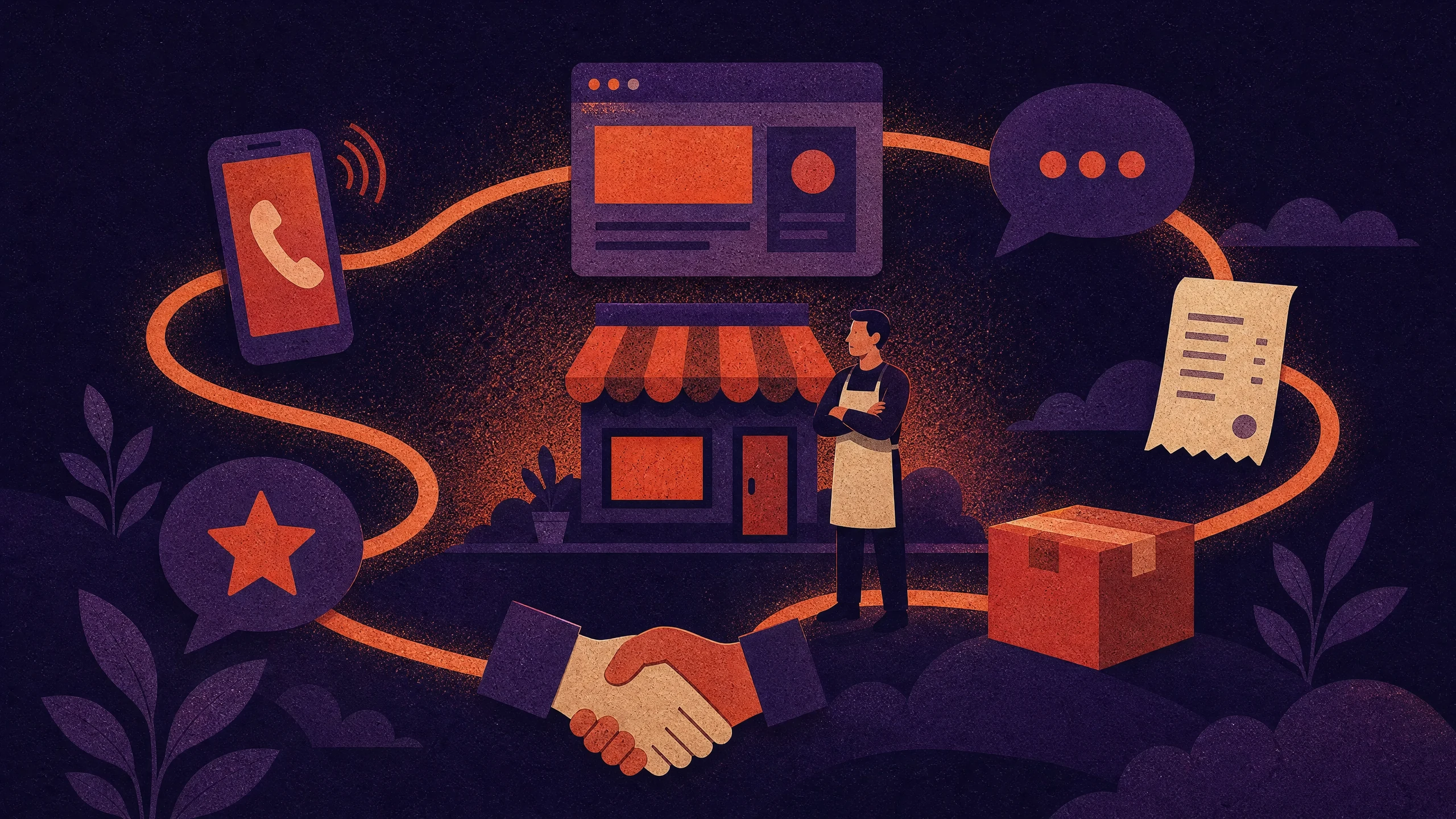
A customer calls your business and waits two days for a reply. Another visits your website and cannot tell whether you serve their area or how to request a quote. A third walks into your storefront and is met with indifference.
None of these businesses ran an advertisement that day. Yet all three were marketing.
That is the truth many business owners overlook: your business is always marketing. Every interaction, including the unplanned, routine, and supposedly insignificant ones, teaches people what they can expect from you. It either strengthens your reputation or quietly weakens it.
Marketing is the full experience of discovering, considering, buying from, and remembering your business.
People Believe What They Experience
Your brand can make a promise, but customers decide whether to believe it through experience.
You may describe your company as responsive, professional, friendly, local, premium, or dependable. Those words have no real weight until customers see them expressed in your behavior. A fast reply to an inquiry makes “responsive” believable. A clean estimate with clear next steps makes “professional” believable. A staff member who remembers a returning customer makes “friendly” believable.
The opposite is also true. A beautiful website paired with confusing communication creates doubt, and a polished social presence paired with poor service creates disappointment.
Customers do not separate the parts of your business as neatly as you do. To them, the follow-up, invoice, scheduling process, email tone, and way you handle a problem are marketing. Every one of these moments answers the same question: “Is this the kind of business I want to work with?”
This is why trust is your greatest marketing asset. Customers believe the pattern they experience more than the claim they read.
The Customer Journey Has No Department Lines
Inside a growing company, work gets divided into departments. That structure may be useful internally, but it is invisible to the customer.
A customer experiences one business, not four departments. If the marketing promises simplicity but billing feels confusing, the promise is broken. If the sales conversation feels personal but the handoff after purchase feels cold, the relationship changes. If your team delivers excellent work but makes it difficult to schedule, pay, or get an answer, the customer remembers the friction as part of the service.
For small businesses, the advantage is the ability to make the customer journey more human, consistent, and easy to navigate than a larger competitor can. The goal is not to turn every employee into a salesperson. It is to help everyone understand that they shape the business’s reputation.
That consistency also needs to extend online. Google’s Business Profile guidelines ask businesses to represent themselves accurately and consistently, including their address, service area, categories, and real-world branding. A clear managed website, accurate local presence, and dependable follow-up should all tell the same story.
The Everyday Moments That Carry the Most Weight
Big gestures can be memorable, but trust is usually built through smaller, repeated moments. These are the places where customers decide whether your promise feels real.
What everyday customer touchpoints communicate
| Your website | **Customers ask:** Can I understand this business and take the next step? **Standard:** Make services, service areas, proof, and contact options easy to find. |
| Your first response | **Customers ask:** Do they value my time and take my need seriously? **Standard:** Reply promptly, clearly, and with a helpful next step. |
| An estimate or proposal | **Customers ask:** Do I know what I am agreeing to? **Standard:** Explain scope, expectations, timing, and cost without unnecessary jargon. |
| Your service delivery | **Customers ask:** Did the experience match the promise? **Standard:** Communicate proactively and do the work with consistent care. |
| A problem or complaint | **Customers ask:** Will they take responsibility when things become difficult? **Standard:** Acknowledge the issue, offer a fair solution, and follow through. |
| The follow-up | **Customers ask:** Was I only valuable before I paid? **Standard:** Check in, invite feedback, and remain easy to reach. |
None of these standards requires a clever campaign. They require attention, discipline, and respect for the customer’s perspective.
The business that gets these fundamentals right becomes easier to trust, choose, recommend, and retain. A thoughtful managed reputation process can help turn those experiences into honest feedback and consistent responses. If you request or feature reviews, the FTC’s guidance on endorsements and reviews is a useful reminder that customer feedback should remain genuine and accurately represented.
Internal Culture Shows Up Externally
How your business operates behind the scenes eventually becomes visible to customers.
If your team is unclear about priorities, customers will feel it in slow responses and missed handoffs. If staff are afraid to raise a problem, customers will experience avoidable mistakes. If the owner says that service matters but rewards only speed or sales volume, the real priority will show up in the customer experience.
Marketing cannot be handed off entirely to one person, department, or outside partner. Your message can be sharpened and your visibility improved, but the business itself must deliver the experience it promises.
The strongest marketing and operations work together. Marketing gives customers a clear expectation. Operations makes that expectation true. When they are aligned, growth becomes more sustainable because every new customer enters an experience designed to reinforce the decision they just made.
When they are disconnected, growth exposes the weakness. More leads do not fix a poor response process, and more followers do not compensate for disappointing service.
Consistency Is More Powerful Than Occasional Excellence
Small business owners often feel pressure to make a dramatic impression. They look for the big campaign, the viral post, the redesign, or the new promotion that will suddenly change everything.
Those efforts can help. But they will never be as powerful as a business that is reliably good at the basics.
A business that returns calls, arrives prepared, communicates clearly, honors its commitments, and treats people well creates a pattern customers can trust. That pattern compounds over time. It becomes the review someone leaves, the referral someone makes, and the reason a customer never bothers to look for another option.
You do not need to be remarkable in every moment. You need to be dependable in the moments that matter. Consistency is not flashy, but it is persuasive. A regular social media presence can reinforce that pattern, but it works best when it reflects a business that is equally consistent offline.
The Igniter Mindset
Take a step back and look at your business the way a first-time customer would. Do not begin with your marketing materials. Begin with the journey.
What happens when someone searches for you? When they call? When they ask a question? When they receive a quote? When something goes wrong? When the transaction is complete?
Each stage is an opportunity to demonstrate who you are. Each stage either confirms or contradicts the message you put into the world.
The most effective marketing is not a layer you add on top of the business. It is the business, operating with enough clarity and care that people naturally want to talk about it.
Your business is always marketing. Make sure it is telling the truth you want customers to remember.
- 1Walk through your customer journey from the first search to the final follow-up. Write down every moment where uncertainty, delay, or inconsistency could weaken trust.
- 2Set one clear standard for response time, estimates, handoffs, and problem resolution so customers receive the same dependable experience from every team member.
- 3Review your website, Google Business Profile, social channels, and review responses together. They should reflect the same services, service area, tone, and promise.
- 4Next week: Great Businesses Are Built, Not Promoted. Promotion can accelerate a strong business, but it cannot replace one.
Ready to strengthen every customer touchpoint?
Igniter Digital helps small businesses create a more consistent customer journey across their website, social media, local visibility, and online reputation. Let’s make the experience behind your marketing as strong as the message.
Start the ConversationContinue the Igniter Manifesto
Each idea in the series builds on the last. Continue with the themes that make the current principle more useful in practice.
Branding Is Keeping Promises
Return to the principle that branding earns meaning only when the business consistently keeps its promise.
Trust Is Your Greatest Marketing Asset
See why dependable details and accountable service make every marketing message more believable.