
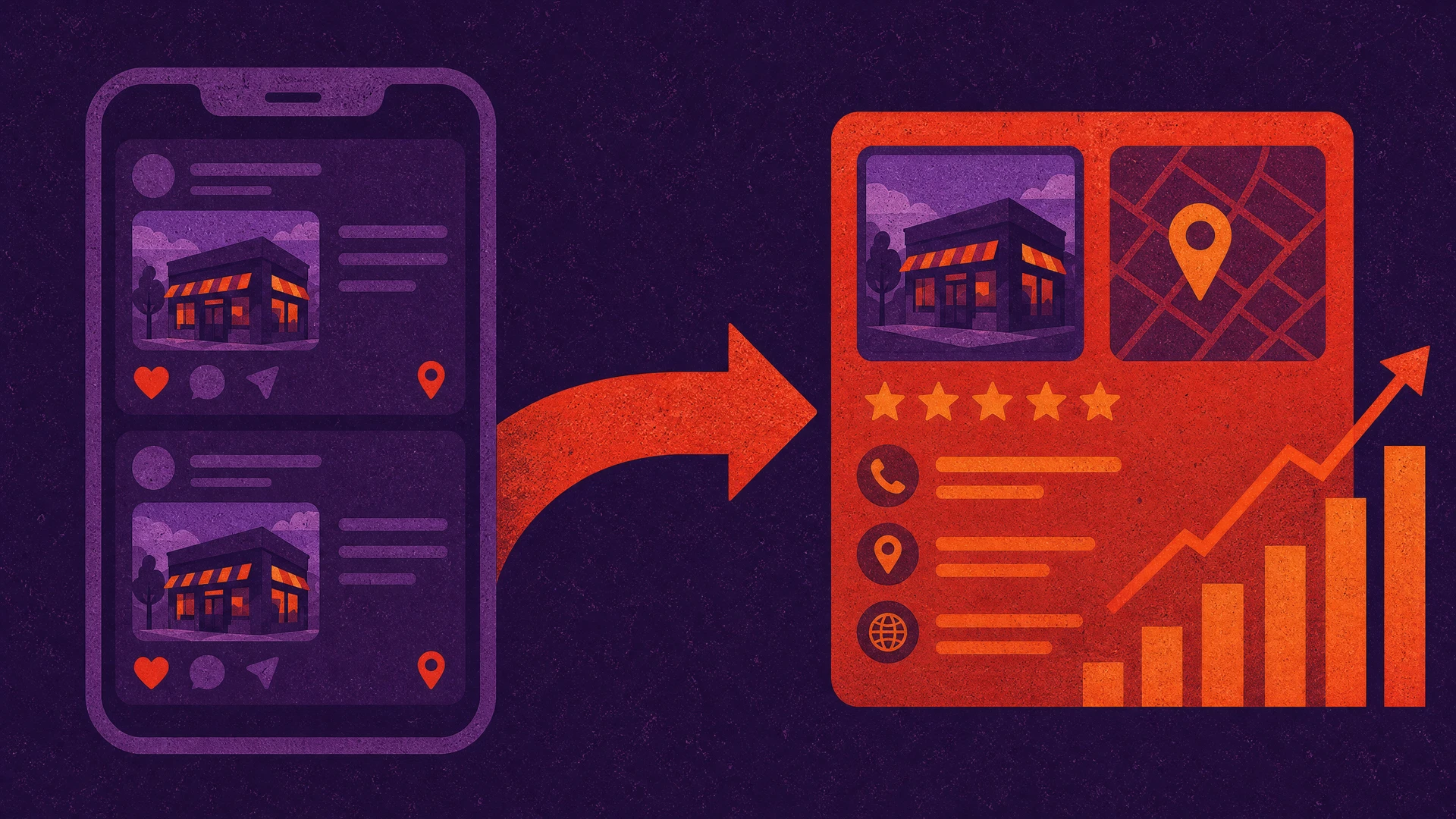
Every few weeks, a small business owner asks us some version of the same question: "If I've only got so much to spend, should I put it into social or into Google?" It's a reasonable question. It's also the wrong one. Social and search are not competing budget lines. They are two stages of one customer journey. Social introduces you. Search decides whether you get hired. A business funding only one of them is paying to start a process it can't finish.
Step one: someone runs into you when they weren't looking
Think about how you found the last restaurant you tried, or the contractor you called. Odds are you weren't actively searching. Someone in a Facebook group asked who does good HVAC work and your neighbor tagged a name. A before-and-after photo showed up in your Instagram feed and you saved it. A short video made you think, "I didn't know that was a thing, but I want it." That's social doing its job. According to Sprout Social's 2026 statistics, TikTok, Instagram, and YouTube together now drive more than 60% of product discovery. People are running into businesses they weren't looking for, and social is the engine making that happen. This is genuinely valuable. Discovery is the hardest part of the customer journey to manufacture. But discovery is only step one.
Step two: they go check you out
Here's what happens after someone sees your post, your review mention, or your tagged photo: they go look you up. They search your name on Google. They look at your Google Business Profile. They read your reviews. They check your website. They do this before they call you, before they fill out your contact form, before they walk in the door. And the bar for passing that check has gotten significantly higher.
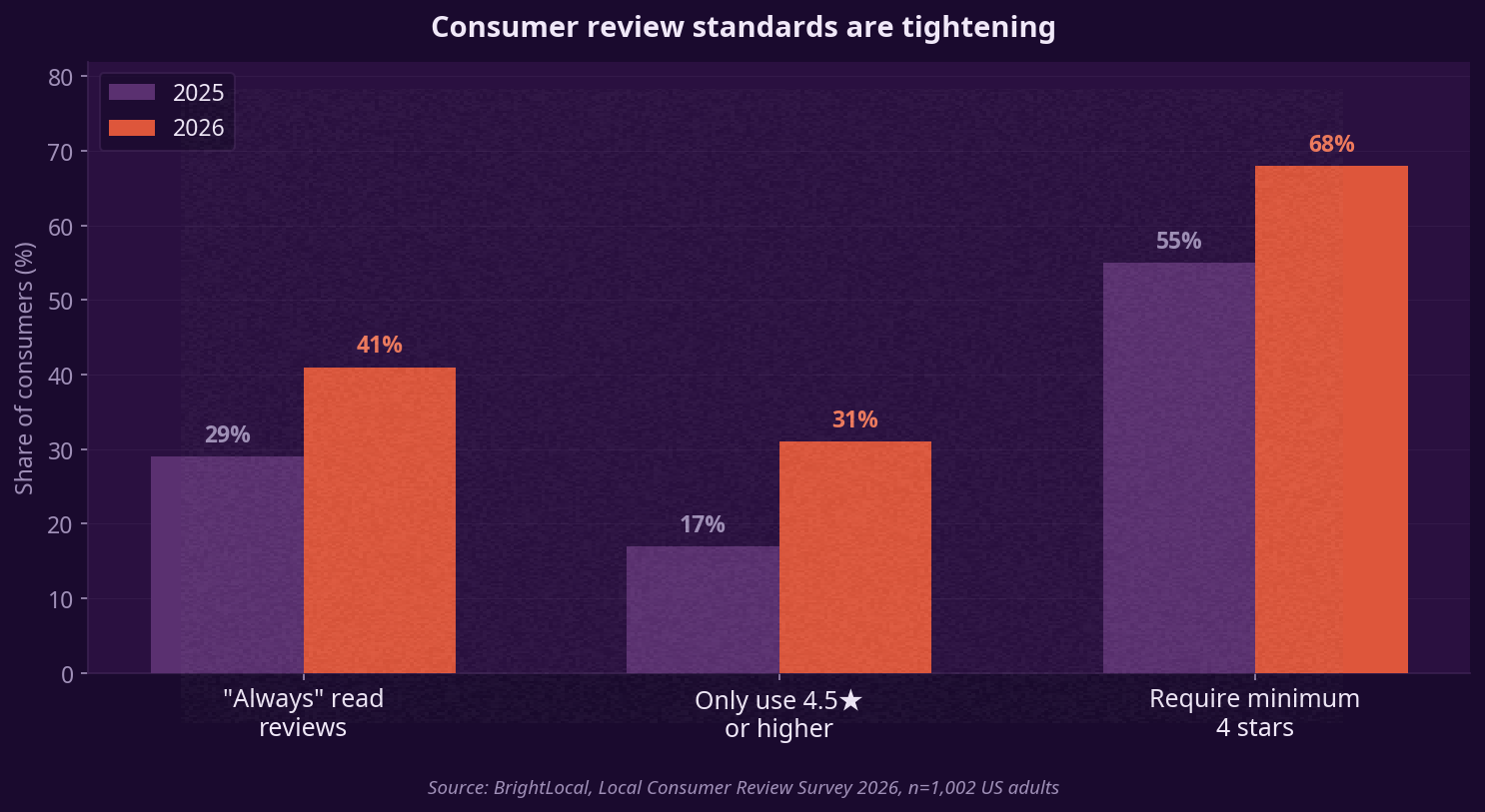
BrightLocal's 2026 Local Consumer Review Survey found that 41% of consumers now "always" read reviews when browsing for a business — up from 29% the year before. The share of consumers who will only use a business rated 4.5 stars or higher jumped from 17% to 31% in a single year. Nearly 7 in 10 consumers now require a minimum 4-star rating before they'll consider a business at all.
Source: BrightLocal, Local Consumer Review Survey 2026, n=1,002 US adults
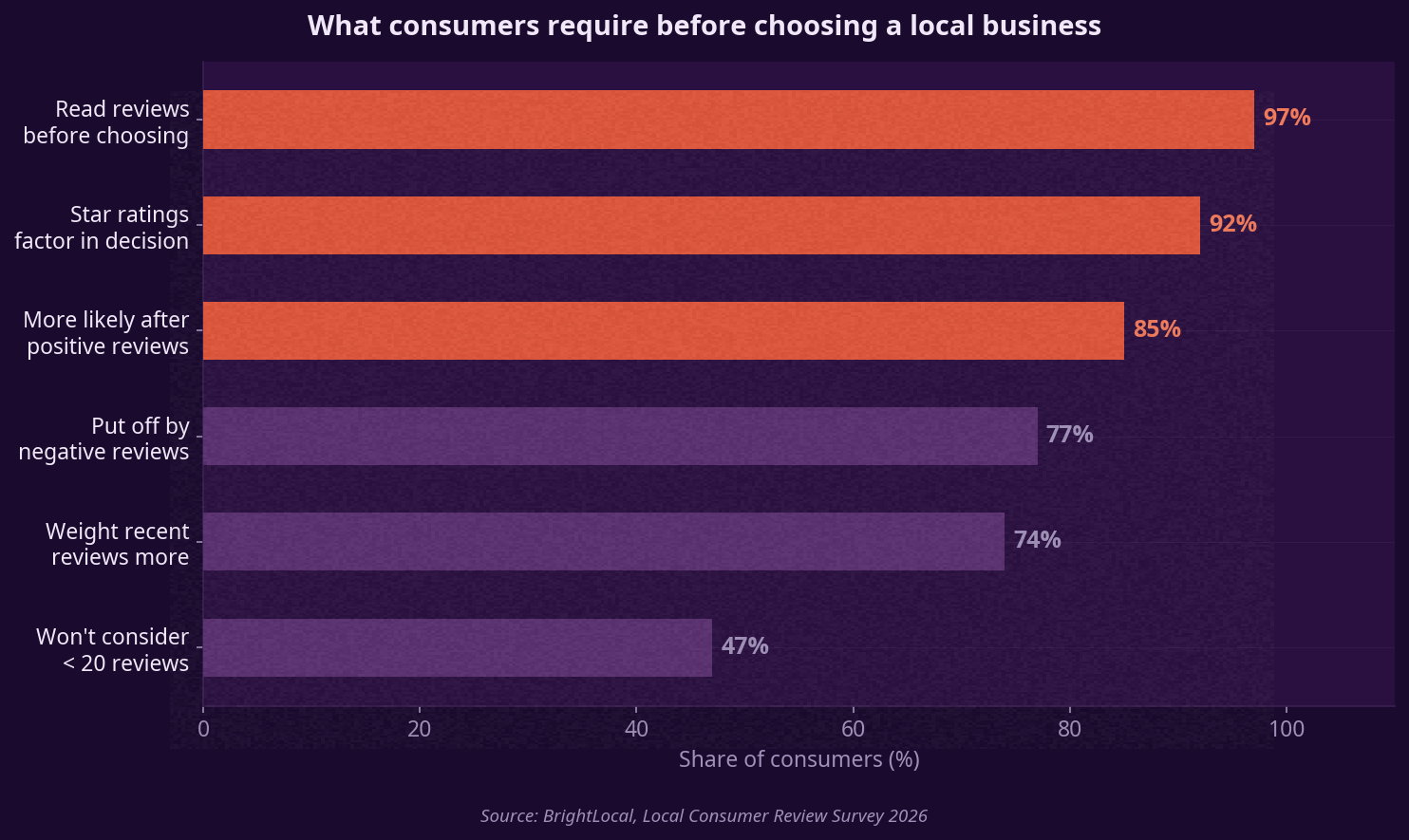
The same survey found that 97% of consumers read reviews before choosing a local business, 92% say star ratings factor into their decision, and 47% won't consider a business with fewer than 20 reviews. That last number is worth sitting with. Nearly half of the people social is sending your way will disqualify you before they ever contact you — not because of anything you did wrong, but because you don't have enough reviews yet.
Source: BrightLocal, Local Consumer Review Survey 2026
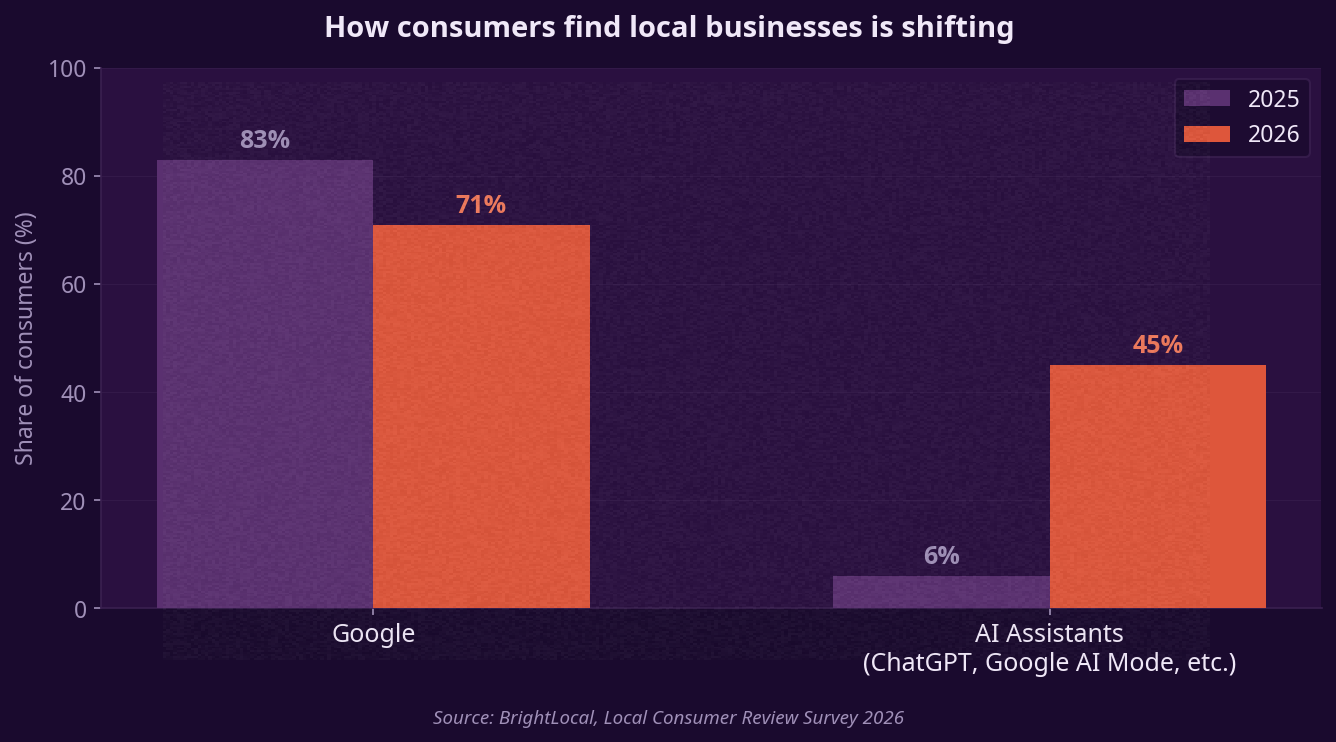
Consumers also now consult an average of 6 different review platforms before choosing a business. Google is still the dominant starting point, but its share of local business searches dropped from 83% to 71% between 2025 and 2026. The gap is being filled by AI assistants: ChatGPT, Google AI Mode, and similar tools went from 6% to 45% usage for finding local business recommendations in the same period.
Source: BrightLocal, Local Consumer Review Survey 2026
AI assistants don't just pull your star rating — they synthesize your reviews, your website content, and your online presence into a summary recommendation. If your profile is thin, your reviews are sparse, or your information is inconsistent across platforms, the AI may not recommend you at all.
Where the handoff breaks
Social gets people interested. Search is where they verify. The handoff between those two stages breaks in four predictable places.
- 1An incomplete or outdated Google Business Profile. If your hours are wrong, your photos are from three years ago, or your category doesn't match what you actually do, you're losing people who were already interested. A complete, accurate, active GBP is the single highest-leverage thing most small businesses can do for local search.
- 2Too few reviews, or reviews that are too old. Recency matters. BrightLocal found that 74% of consumers weight recent reviews more heavily than older ones. Twenty reviews from 2022 won't carry the same weight as eight from this month — and 47% of consumers won't consider you at all below 20 total. Getting reviews has to become a repeatable part of how you close out every job.
- 3A website that doesn't match the quality of the post that sent them there. If a beautifully shot Instagram reel drives someone to a website that looks like it was built in 2014, you've broken the trust you just earned. The website is where the decision gets made.
- 4Unanswered messages. Sprout Social's 2026 data found that 73% of consumers will buy from a competitor if a brand doesn't respond to them on social media. If someone comments on your post or sends a DM and hears nothing back, you've lost them.
What to do this month
You don't need to do everything at once. Start here.
- 1Claim and fully complete your Google Business Profile. Every field. Real photos. Accurate hours. The right primary category.
- 2Get past 20 reviews. Build the ask into your close-out process — after every job, every appointment, every sale. Make it a habit, not an afterthought.
- 3Spread your reviews across multiple platforms, not just Google. Yelp, Facebook, and industry-specific sites all feed into the picture consumers and AI assistants are building of you.
- 4Respond to every review — the good ones and the bad ones. A thoughtful response to a negative review often does more for your reputation than the review itself.
- 5Keep your name, address, and phone number consistent everywhere they appear online. Inconsistent NAP data confuses search engines and undermines your local rankings.
- 6Post proof of work rather than announcements. Before-and-after photos, short project videos, and customer stories drive discovery. 'We're open on Sundays!' does not.
- 7Send social traffic to a page built to convert. If your bio link goes to your homepage and your homepage doesn't have a clear call to action, you're losing people at the finish line.
One warning about measuring this
If you're tracking where your customers come from using Google Analytics or your CRM's default attribution, you're probably giving search too much credit. Last-click attribution — the most common default — assigns the sale to the last thing the customer touched before converting. That's usually a Google search for your name. But that search only happened because social introduced you first. Cut social, and the branded searches dry up. The attribution model just won't tell you that until it's too late. The low-tech fix: ask every new customer how they heard about you and write it down. Not a dropdown in a form — an actual conversation. "How did you find us?" You'll start to see patterns that no analytics dashboard will show you.
"Social and search aren't competing for your budget. They're working in sequence. One starts the conversation; the other closes it."
— James TaylorNot sure where your handoff is breaking?
We offer a free visibility check: a Google Business Profile audit, a review presence scan across major platforms, and an honest look at how your website handles the traffic social is already sending you.
Get Your Free Visibility Check